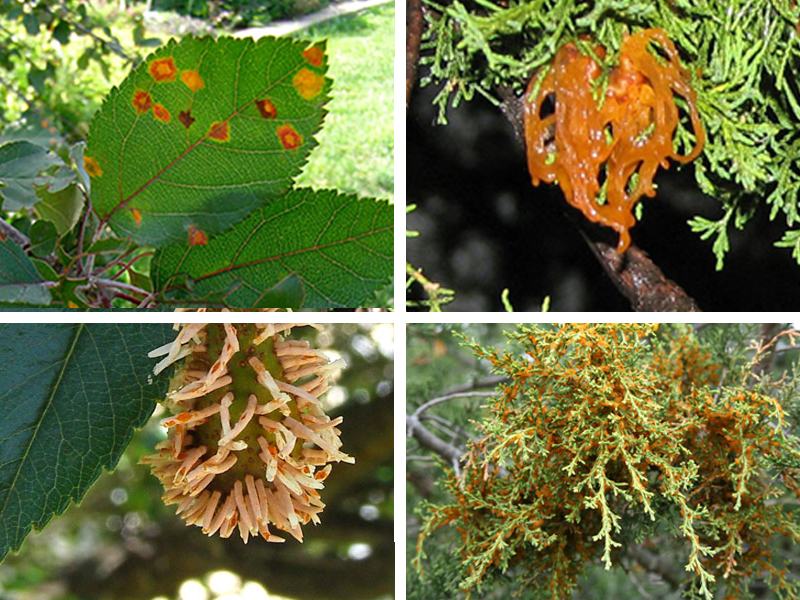
Cedar-Apple Rust
You may be seeing orange gelatinous blobs with what looks like tentacles on redcedar or juniper trees now or soon as we get more warm wet weather. This is cedar-apple rust, which is a fungus and as the name suggests requires two hosts to complete its lifecycle, cedars and apples. Cedar-apple rust is typically a non-injurious disease on redcedar and juniper, however on apple, the pathogen can infect leaves and fruit of susceptible cultivars and may cause premature defoliation if infection is severe.
Life cycle
Redcedar/juniper, becomes infected by spores released from aecia on apple/crabapple in mid-summer. The pathogen then grows and begins to induce the formation of galls on the tree the following summer, which continue to grow throughout fall and winter. With rainfall increasing in early spring, the galls develop telial horns (the tentacles), which is the fruiting body that will produce spores that can be carried for several miles on the wind. Those spores that land on the alternate host, apple/crabapple, will develop into lesions on leaves or fruit which form small pustules on the upper side of the lesion surface. Eventually they will develop thick tube-like protrusions called aecia on the underside of the lesion. This fruiting body produces spores, which are released into the air and land on nearby redcedar/juniper around mid-summer causing the life cycle to repeat itself.